Budapest
2026
In the book Filterworld, Kyle Chayka uses a term of “algorithmic homogenization” to describe how interior spaces across different cities, countries and continents start looking the same. Chayka shows that today looking at pictures and short videos of one’s home, one cannot know where this home is located. Chayka argues, because of the global homogenization of interiors. The creators are all chasing the same visual approval over social media; today to be acknowledged and appreciated, one’s home should have a set of elements that could be recognized by others, who probably would never step a foot in that home.
In our globalizing world similar processes take place with many phenomena, and radical left scene is not an exception. Standards and categories of estimating “levels” of fascism, patriarchy or economic exploitation as well as the struggles against them often are not contextualized. Political work, in particular, is often imposed or imported without a hard work of contextualization. However, such work, by obtaining a certain “language” or a recognizable style, has a better chance to be acknowledged by our foreign camaraderie. Following these strategies, the global movement may risk preferring practices and perspectives of more visible– read: bigger and more resourceful – movements over more contextualized categories and practices.
Diversity in strategies and approaches which would be more rooted in historical and political contexts need to lie at the heart at internationalization.
The authors of the zine hope that by writing down our reflections on the “Free Maja” campaign from Budapest — where the campaign has found itself after being organized in Germany by Maja’s family, friends, and comrades— we can contribute to the understanding of complications and challenges of carrying political fights across different places and contexts – if without critically questioning the ground. We hope, therefore, this zine is a contribution to the discussion on what international solidarity looks and may look like in practice.
Preface
Each February Budapest hosts annual demonstration “Day of Honor” – a day of celebration that unites fascists from Europe to commemorate Hungarian fascists („nyilasok”) and regular troops who perished in the siege of Budapest by the Soviet army in 1945. Correspondingly, on the same day each year there is a counter-demonstration to protest against this fascist gathering and the following hike. The counter-demonstration, in the last years, has become significantly internationalized by comrades arriving from various countries of Europe.
Three years ago, in February 2023, on the eve of these events, several attacks against far-right people took place. One of the accidents was filmed by a random camera, with none of the participants at the event counting on it. The video was published in some social media accounts, many comrades including us were confused about how to interpret what had happened, and what exactly had happened. We were terrified that there would be revenge and that Pandora’s box is open—street violence, something we hadn’t seen in decades, and in which, we knew, we would quickly be defeated.
Soon the police were on the street attacks: first, Budapest police arrested a Hungarian person, a member of Szikra – a social-democratic political youth organization which is the most well-known left-oriented organization in Hungarian politics. The person was arrested on suspicion of participating in a beating and was detained for two weeks with the following release as no proof has been found. Next, in the upcoming days, several other people – all foreigners – were arrested in Budapest suspected of participating in the event of beating a fascist. Afterwards, in a couple of weeks, house searchers and arrests started to take place in different cities of Germany – and later in Italy, on ongoing basis, for years.
One of the arrested, anti-fascist Gabriele, was arrested in November 2023 in Italy. By a decision of the court of Milan in March 2024, Gabriele was not extradited to Hungary. The decision was officially based on potential conditions in Hungary, which – as it was claimed – worse than in Italy. In December 2023, anti-fascist Maja was arrested in Berlin, and in March 2024 – the same month when Gabriele’s extradition was not approved –the court has granted the extradition of Maja to Hungary.
A campaign in Germany against Maja’s extradition has started. One month after, in June 2024, the Berlin Court of Appeal has decided to extradite Maja to Hungary, and such a procedure was taken place in an extreme hurry: just several hours after that decision, Maja in the night has been taken from Berlin and brought through the border to Hungary. Next day, in the night, the Federal Constitutional Court approved Maja’s lawyers’ urgent motion and ordered to suspend the extradition and return Maja to Germany. By that point, about an hour earlier, Maja had already been handed over to Hungarian authorities and was not brought back. Therefore, the extradition is considered by many comrades as illegal and, according to BASC, whose website is the source of much of the aforementioned information (we translated the info from German by an AI), Maja’s extradition is one of the most controversial Germany’s extraditions in the last years.
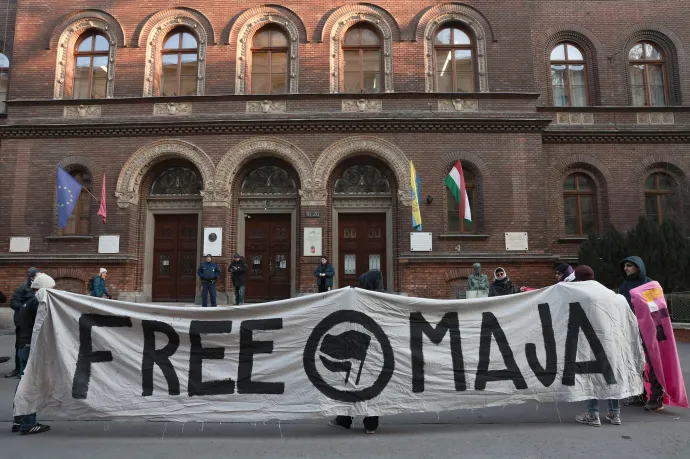
Since then, there is a campaign “Free Maja”, to support Maja in her struggle with Hungarian court. Hundreds of protests pass through Berlin, Leipzig, Jena, Hamburg, Dresden and other German cities that demand the return transfer of Maja to Germany! Politicians, namely of the Linke party, raise concerns over the prison conditions and the absence of the “rule of law” in Hungarian state. The campaign around Maja’s detention and arrest is accompanied by “Bring Maja Back” slogan, the corresponding posters and graffities can be found in various leftist cafes and bars, shops, car-garages, manufactures, printing stores and on the streets of big and smaller cities of Germany, and contributes to mainstream narratives of demonizing Hungary.
Many people started regularly coming from Germany and Austria to Budapest, prior to the days of trials to support Maja. Even Hungarian neoliberal media outlets, which were ignorant to anti-fascist and leftist struggles or depicted them as events hold by some radicals, covered a campaign in front of the court. Previously barely unheard “anti-fascists” in Hungarian context, started to appear in media and was linked immediately to German language and German context.
Many of us have been meeting the comrades and/or hosting them. We observed, with the campaign growing, different people who had little understanding or interest in our politics and struggles before, were quick to judge, and unfortunately, even to teach us. This experience inspired us to write this zine to make some important statements.
Disclaimer
Before we proceed to critically discuss our experience with the campaign how we saw it in Budapest and from Budapest, we would like to clarify a few things before.
- We support Maja as a prisoner, as a person who stands against a huge bureaucratic nation-state machine which seeks only to pursue its ideological interests which don’t align with our interests.
- Fight for releasing Maja and other antifa comrades out of prison is predominantly run under the slogan “Free All Antifas”, which consequently became one of the most popular and pronounced campaigns on the left. We have to state it clearly:
We stand here for the total abolishment of the punishment systems. We believe that prisons should be abolished entirely. We believe that everyone should be released. Not only our comrades, but many other people. Incarceration system is not an answer to social issues! Abolish prison system! Free Maja and all the imprisoned people! - By criticizing some aspects of the campaign, we do NOT imply that we are against physical violence per se (whether Maja was involved or not).
- On these pages, we discuss how the campaign has been pronounced by our comrades in our view, and how it is perceived on our part of the movement. We do not address the legal framework and its opportunities and limitations. This is about the campaign and the international solidarity among comrades.
There Are Multiple Strategies of Fighting Fascism, Aren’t There?
The question of supporting Maja and the corresponding campaign did not bother itself with the question of the actual violent act. The campaign left the question, whether such actions as it happened in Hungarian / Budapest context are approved, to be continued or condemned, without answer. We mean here not the question of Maja’s participation in it – which intersects with a legal case, but rather a position of the campaign on this question. For us, one cannot run the campaign “Free Maja” without stating their position on this.
The discussion of development of political work in uneven context with more resources to financial and cultural facilities and infrastructures is not new to the radical left scene. The campaign’s position on a matter of physical violence per se (1) and on a question of people who don’t reside in Budapest and who come to the city to do this “political work” (2) would be very necessary.
Such statements and stated positions would demonstrate that the questions of – what has happened in Budapest, how it affects comrades residing in the city and in the country – is addressed, and therefore of importance for the campaigners. However, these questions are largely absent from the campaign. Not only the question how the events-2023 affected left movement in Hungary is absent, raising up this question itself has been equalized to being an enemy of anti-fascism.
Why so? The beating of fascists and street violence has been considered of the primary ways of fighting fascism, if not the only one effective. This approach has been predominant in the places with a considerably big – or definitely, the most visible in Europe – left movements in Germany, Greece, Spain among others. For many of us from central and eastern Europe this was rather new, and we had to learn that street violence between fascists and anti-fascists has been considered a norm, or a historical necessity.
However, it is important to note that the world has witnessed diverse strategies for fighting for freedom from capitalist and/or fascist systems. These range from establishing and fighting for self-sufficient communities existing outside the nation-state framework, such as in Kurdistan or with the Zapatistas, to a strategy of personal transformation intended to liberate the individual self. On a mass scale, this approach seeks to non-violently transform society from within—a philosophy embraced by hippies and other left-oriented groups in the US during the 1970s. Another key strategy is infiltrating and altering institutional structures from the inside, known as the “long march through the institutions,” inspired by Rudi Dutschke in the 1960s and 70s. Not even mentioning the revolutionary terrorism of killing famous and powerful people like tsars or politicians – a centuries old strategy.
Even in recent modern history, strategies for combating fascism have varied dramatically in their methods and approaches. Despite this diversity, a focus on confronting street-level, grassroots fascist movements remains predominant and is rarely questioned aloud. A recent AK article[1] by Raul Zelik interrogates this question in the German context. The author challenges the notion that the alarming rise of contemporary fascization is driven primarily by far-right movements. Instead, he argues that the primary engine of this process is often not the extremist movement itself, but the state, its institutions, and the broader global capitalist system. This perspective fundamentally shifts the focus: if fascization is deeply embedded within state structures and economic logic, then effective opposition may require strategies radically different from those aimed solely at fighting grassroots fascists.
Decisions Affecting Us, Without Us (or briefly about the lack of CEE[2] on the european and global leftist map)
As noted earlier, the strategy of direct physical confrontation with fascists has not been a widely accepted or widely practiced approach on Budapest’s streets. It is because of this context, the incident of 2023 was not only startling but also deeply unsettling or even frightening for many of us, as there was a genuine fear that such actions could unleash unforeseen and uncontrollable consequences. We understood, that if this precedent were set, it could fundamentally change the dynamics on the ground – most definitely, to our sever disadvantage.
We asked ourselves: could a group of people who acted that way truly have been unconcerned with these possible outcomes? How did this idea come to their mind? Did they consult anyhow with people who have been living here and were well aware of the context? If so, was it a way to shift our realities towards more accepted methods and lifestyles widespread in the west? Was it a way to “save” our streets from the perceived disgrace of anti-fascist “inaction” in an increasingly authoritarian and growingly fascist Hungary?
While we cannot know the motivations behind these actions, we can observe the disregard for the local context and the lack of interest in the consequences for us. Such a dynamic raises important questions about the impact and ethics of importing activist strategies in a different sociopolitical context.
Not only were the consequences of this interference with our local balance of power left unexamined, but the Budapest leftist community was also neither consulted nor informed about these actions. As often happens in broader European and global leftist discussions about strategies against capitalism and fascism, our perspectives were overlooked—and, once again, decisions affecting us were made without our input. This time, we faced the consequences in the city and country where we live, work, and organize, and were left alone to deal with the structural consequences of the events, on top of other overwhelming events taking place in the country.
The Limits of a Dialogue
The concerns have been raised with a few comrades. The issues raised concerned the attitude to street violence, to a matter of bringing these methods outside of a known context and the place of Budapest perspectives in the campaign. In a nutshell, we asked how these people who actively engage and support “Free Maja” campaign see the consequences and the role for and of Budapest.
Unfortunately, besides few exceptions, we have found a strict orthodoxy and “loyalty” concerning strategies: these practices of street violence are widely spread and supported in Germany, they are treated as both effective and morally justifiable. For many comrades from Germany, our doubts spoke only of our un-educatedness and our politically “underdeveloped” leftists’ movements. Little room was left for alternative viewpoints or approaches. In discussions about anti-fascist street actions, we could only observe a tendency to conflate criticism of these tactics with opposition to anti-fascist stance as a whole, making any critical engagement with these methods difficult or unwelcome.
Of course, any honest conversation about strategies would have also addressed the differences between our ways of living, the economic differences as well as historical ones. This is not an easy topic: our societies are entangled today under global capitalism, which influences not only the economic strategies of the countries but also of individuals. These dynamics affect the movements and the strategies which could be sustainable in different ways. Yet, the space for such critical dialogue was almost non-existent. More often than not, conversations turned into us receiving advice: we were told how to build a movement, how to organize ourselves, and how to choose our allies, both locally and internationally.
A little add-note:
It did not escape us that, according to some comrades, the priorities in the anti-fascist struggle seemed to be pre-defined. For them, anti-fascism often means “never again fascism,” and with a clear focus on Jewish victims. Little attention is given to other groups. But in Hungary, for example, the primary targets of fascists are the Roma, who were also, by the way, victims of the Holocaust. This perspective rarely received more than token support. When we hesitated to accept that the Jewish community should be seen as the main victims of current fascist threats, we were quickly dismissed as politically naïve or even accused of inherited anti-Semitism. The argument was made, implicitly or openly, that if you do not see Jews as the foremost targets of fascism, you do not take the issue seriously and have to work on your inner antisemitism. This kind of arrogance, expressed by imposing one’s vision and perspective based on belonging to a more visible and larger radical-left movement is both striking and puzzling.
However, the saddest part is that such an attitude shuts down possibilities for meaningful dialogue. It begs the question: why do some people presume knowing what is best in contexts where they lack familiarity with the specific history, balance of social powers, pressing issues, or underlying political dynamics?
The answer may lie in the tendency to universalize one’s own experiences, failing to acknowledge that your experience is shaped by its specific context and has its limitations. However, the homogenization of discourse leaves behind the important nuances; and if in general it all might looks just right. In detail it is rather superficial. Acknowledging the differences is crucial for building understanding and collaboration, and for avoiding paternalism.
If our encounters have taught us anything, it is that real international solidarity has a long way to go, and we have a hard task in front of ourselves: to overcome the challenges of being embedded in an unequal capitalist world, rather than simply dismissing them. Otherwise, we are left with a one-way flow of advice, rather than an honest two-sided exchange of ideas. Only by recognizing the diversity of experiences and strategies within the various system of constraints and opportunities, can we hope to build the broad and strong movements our times demand.
Don’t Blame the Periphery—Blame the System and its Core
We see the reasons for such broken dynamics in a broader context. We believe that the dynamics within the radical left movement often mirror those of society at large. In our experience, some of the attitudes we have encountered from German comrades appear to reflect broader societal and political patterns, namely in seeing what happens in Hungary as backward, illiberal, somehow worse than suggested by western liberal democracies. When such superstitions are not critically examined, but reproduced in the radical left movement, we strengthen the system we live within.
As leftists, we consider it our responsibility to remain vigilant and critical of all forms of hierarchy and dominance, particularly those rooted in the historical uneven development of global capitalism. Therefore, in this last section we would like to identify a couple of issues that might have caused such an unbalanced dynamic in the campaign.
- Politically Naive Eastern Europeans? Hierarchies Among Countries, Hierarchies Within the Left
As noted above, the hierarchies that exist between countries are often reproduced within leftist movements themselves. Philosopher Boris Buden, in his influential essay “Children of Post communism” (2010)[3], describes a persistent issue: the tendency to view people from Eastern Europe as “political children.” Buden argues that after the fall of state socialism, Eastern Europeans were suddenly repositioned as “children” in relation to the so-called “West”, which appeared as the “adult” or mature subject of history, immature or inexperienced in comparison to the supposedly “adult” West, which was seen as the mature subject of history. This metaphor highlights how Eastern Europeans were treated as inexperienced and in need of education in democracy and capitalism by their Western counterparts. The relationship that develops from this assumption is fundamentally asymmetric and has had a profound effect on cultural and political dynamics in post-socialist societies.
Unfortunately, these patterns are reflected even within radical leftist circles. This is not surprising: leftist scenes do not exist in a vacuum, no matter how much we might prefer to believe otherwise. It is our political work to build relationships while reminding ourselves about these embedded hierarchies, instead of overlooking them. This goes both ways.
Therefore, our political work must be guided by the principle of recognizing one another in the anti-fascist and anti-capitalist struggles, rejecting imposed categories of success, or legitimacy, and avoiding competition over visibility or recognition within the movement. We must acknowledge that our struggles may differ in concrete ways—even if we share the broader goal of fighting capitalism.
Only through critical solidarity can we hope to overcome the divisions imposed by history and capitalism. - Blaming “Authoritarian Anomaly”, Missing the Systemic Roots
It is common practice to discuss Viktor Orbán and his policies as an alarming deviation—a malfunction within an otherwise smoothly operating neoliberal democratic system of the West. But what if the rise of radical right-wing parties and their politics is, in fact, an organic product of this very system? What if such developments are not a break from neoliberal democracy, but rather its logical extension—if not culmination?
As an example, from migration politics which Orbán has been famous for years, sociologist Céline Cantat has shown in her research[4] that “official Hungarian discourses and practices on migration and asylum are in fact strongly aligned not only with EU migration policy, but also with identity narratives at the heart of the European project.” In other words, Hungary’s approach to migration is not a unique outlier, but is deeply resonant with the wider logic and narratives structuring EU border and identity policies.
The portrayal of Orbán as uniquely monstrous or the Hungarian regime as singularly regressive becomes a convenient narrative. It allows to externalize the crisis—to imagine that the real danger lies outside the “civilized” core of Europe, in its peripheries, rather than in the very center of the liberal order. However, one does not exist without the other.
Neoliberalism is deeply rooted in the processes of globalization and the global division of labor. Since the 1980s, the world has become vastly more integrated, and the ability of individual countries to determine their own paths—economically, politically, or socially—has diminished. Global capital, historically western and increasingly Chinese, plays a decisive role in determining which countries become sites of industry, tourism, fashion, finance, or trade. These structural determinants leave peripheral and semi-peripheral countries with little agency over their destinies. The European Union is not an exception. It has a very clear division of labor, and a very clear hierarchy in the quality of life. This is unshakable within this system.
Focusing on authoritarian Orbán or other “underdeveloped” in democracy eastern Europe is not only misleading—it is deeply dangerous. As radical leftists, we must apply our critical lens not to the scapegoats convenient to liberal regimes, but to the system as a whole, and to vision of an alternative instead.
When we shift our critical attention away from the institutions that exercise real global power—such as the EU and NATO (which are responsible for much of the suffering, within and beyond Hungary), do not we fall into defending the European border regime? Focusing so much on fighting right-wing “challengers” (whether it is the AfD in Germany, Vox in Spain, or Fidesz in Hungary), do not we end up reinforcing the mainstream liberal power order rather than struggling against oppression and exploitation in all their forms?
For the radical left, it is essential not to fall into the trap of defending one side against the other—our critique must be directed at the system as a whole. We urge comrades to keep sight of the deeper structures at play, remaining alert not to reproduce liberal narratives that blame the periphery while excusing the center’s role in perpetuating inequality, exclusion, and violence. - Understanding the Resentment
A deep, lingering resentment towards the core capitalist establishment remains palpable in Hungary and much of Eastern Europe. Decades after the end of state socialism, real independence from Western economic and political interests seems as distant as ever—if not more so. Many are still compelled to migrate to core-capitalist countries simply to experience the standard of living that is considered normal there.
This sense of disappointment and anger—rooted in ongoing structural dependence—has been instrumentalized by Orbán for years. Yet, beneath the surface, this popular frustration is not fundamentally about Orbán himself, but about global capitalism and the institutions that sustain it. They include the European Union, which plays a key role in sustaining this division of labor and political and economic hierarchies. Meanwhile, people in Western countries benefit from this system, which explains both the migration flows and the persistence of inequality.
Presenting core-capitalist countries as “success stories” of liberal democracy erases the reality that their prosperity is built on historical and current patterns of exploitation. The relationship between East and West in Europe—both historically and within the EU—is not an equal partnership; it is one marked by dependence and extraction. Even when people lack the words to name the reasons for the resentment, their lives do not lie. They know, their enemy is not Orbán but capital.
Summary
The February events of 2023 have significantly affected the radical left scene, but in dramatically different ways, which we yet to explore and understand. This text is the beginning of this exploration. Not only did we want to open the discussion and share our point of view, but, inspired by positive experiences of international solidarity which we experience, we also wanted to suggest the reasons for such a split in the campaign. We believe many things have not been reflected upon and decided that we need to formulate and share with you, our reflections.
First, it’s crucial to recognize that comrades operate in different contexts, with different resources and sometimes different goals. There are no universal strategies or one-size-fits-all ideas. One cannot simply show up somewhere and ignore how your actions affect comrades who actually live and work there. Moreover, coming to court hearings needs to start with a reflection on what these events meant to the local community. Such a position would strengthen the campaign and would rather unite the comrades than divide them into those who support Maja and those who don’t.
Second, differences in leftist movements aren’t about being “better” at activism; they grow out of deep historical factors—political histories, legacies, experiences of revolution and counter-revolution, as well as out of concrete resources. The size of institutions, access to funding, infrastructures such as printers, existing groups, setting up logistics etc., and even basic factors like how much people have to work to survive, average wages, and the existence of social support all shape what is possible.
We do not need to be saved from Orbán. We need to be liberated from capital and from western dominance.
Finally, real change won’t come to Hungary just because some people occasionally visit, nor will discourse shift through short-term interventions. You all know that it is the slow, persistent organizing and everyday work of those who live here, plus genuine long-term international solidarity, social relations, and people’s connections that makes the real difference.
Conclusion
We have experienced many meaningful moments of international solidarity in recent years, and we continue working to strengthen these connections and make our movement more resilient. At the same time, the “Free Maja” campaign highlighted some of the painful aspects of internationalism—it brought out old wounds, reinforced certain stereotypes and clichés, and reminded us how much work remains to build truly equal, non-paternalistic forms of collaboration.
By writing this zine, we have made a modest attempt to understand why the “Free Maja” campaign mostly divided the opinions about the campaign depending on the context we socialized within. While many of us are is solidarity with Maja and call for her immediate release, there are different and often undiscussed positions on the ways how the campaign has addressed the event itself and how the campaign includes – if it does at all – the Budapest perspectives. We hope we can contribute to the campaign by adding another layer to it.
FREE MAJA. FREE ALL FROM PRISONS!
ABOLISH CORRECTIONAL SYSTEM!
and may we not forget:
FUCK THE EU’S COLONIAL PRACTICES!
ABOLISH CAPITALISM!
ABOLISH STATES!
Some Anarchists from the so called Hungary
————————————————————————————————
[1] https://www.akweb.de/bewegung/staat-oder-rechte-bewegungen-wer-sind-die-treiber-des-faschismus/
[2] Abbreviation for central and eastern europe
[3] https://www.radicalphilosophy.com/article/children-of-postcommunism
[4] https://lefteast.org/citizenship-and-exclusion-in-contemporary-hungary/